
🧠 AI Summary:
This educational guide explores the realities of Autism Spectrum Disorder (ASD), actively breaking down common misconceptions to foster community empathy and inclusion. Rather than a linear scale, the autism spectrum operates as a diverse wheel of individual traits where every child presents a unique combination of strengths and challenges.
Beyond the Myths: An Educational Guide to Understanding the Autism Spectrum
When it comes to developmental health, misconceptions can build accidental barriers between families and the support they deserve. For many parents navigating a new diagnosis, or community members looking to become better allies, true support begins with education.
Did you know that autism isn’t a single condition, but a broad spectrum?
Autism Spectrum Disorder (ASD) fundamentally affects how people perceive the world, process environments, and interact with others. Because it is a spectrum, every autistic person possesses a completely unique set of strengths, individual traits, and distinct everyday challenges. By moving past outdated stereotypes, we replace judgement with clinical empathy and real-world inclusion.
What Does it Mean That Autism is a Spectrum?
A common point of confusion for many families is the word “spectrum.” People often mistakenly picture a linear line running from “mild” to “severe.” In reality, the autism spectrum operates much more like a colorful wheel or a complex puzzle.
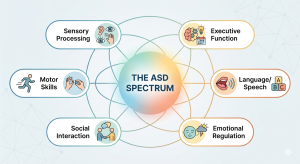
An individual might have highly advanced capabilities in language and speech, but face significant daily barriers with sensory processing or executive functioning. Another person might be completely non-verbal but possess exceptional visual memory and motor skills.
Understanding autism spectrum disorder requires looking at the whole child rather than trying to fit them into a rigid category. This individualized view is precisely why personalized clinical interventions, such as Applied Behavior Analysis (ABA), are so effective—they adapt entirely to the unique blueprint of the child.
3 Core Truths About the Autism Spectrum
To help build a more inclusive community and provide actionable insights for families, let us break down three foundational pillars of the autistic experience.
1. Unique and Diverse Communication Styles
One of the most vital facts to recognize is that communication is not limited to spoken words. Within the spectrum, language develops along highly diverse paths:
- Highly Verbal Individuals: Some children speak fluently, possess expansive vocabularies, and can speak at length about complex topics. They may, however, struggle with the nuances of social pacing, taking turns in conversations, or reading subtle body language.
- Non-Verbal or Minimally Verbal Individuals: A significant portion of the autistic community does not use spoken words to communicate.
- Alternative Communication: Non-verbal does not mean unable to connect. Many individuals utilize American Sign Language (ASL), Picture Exchange Communication Systems (PECS), or high-tech Augmentative and Alternative Communication (AAC) speech-generating tablet devices.
True inclusivity means treating all forms of communication with equal respect and patience.
2. Navigating Sensory Sensitivity and Processing
The physical environment impacts a neurodivergent brain differently than a neurotypical one. Sensory processing differences mean that the brain can either over-respond (hypersensitivity) or under-respond (hyposensitivity) to environmental stimuli:
- Sensory Overload: Bright fluorescent lights, the hum of an air conditioner, crowded grocery stores, or certain clothing textures can feel incredibly overwhelming, distracting, or even physically painful.
- Sensory Seeking: Conversely, some individuals crave extra sensory feedback. They might seek out deep pressure hugs, enjoy spinning, or display a strong fascination with specific visual patterns or sounds.
Recognizing these environmental triggers allows parents and local businesses to create sensory-friendly spaces where children can feel safe, regulated, and ready to learn.
3. The Power of Deep Focus and Special Interests
Many autistic individuals possess an intense ability to focus deeply on specific subjects they love. These are often referred to as “special interests.”
Whether a child is captivated by astronomy, train schedules, marine biology, or complex mathematical patterns, these passions are highly functional assets. Deep focus allows individuals to acquire encyclopedic levels of expertise. In a supportive educational or therapeutic environment, these special interests can be bridged directly to learning goals, social opportunities, and future career strengths.
Shattering Common Autism Myths
To cultivate a community where neurodivergent individuals truly thrive, we must actively dismantle the persistent myths that skew public perception.
| Myth | Clinical Reality |
|---|---|
| Myth: Autistic people do not feel emotion or empathy. | Reality: Autistic individuals feel emotions deeply. They simply process, experience, and express those emotions in non-traditional ways. |
| Myth: Autism is a disease that can or needs to be “cured.” | Reality: Autism is a lifelong neurological variation. Professional support focuses on building independence and functional skills, not erasing identity. |
| Myth: All autistic individuals possess rare “savant” skills. | Reality: While some individuals have exceptional talents, every person on the spectrum has a standard, unique mix of day-to-day strengths and challenges. |
Practical Ways to Practice Community Inclusion
Moving from awareness to active acceptance requires taking deliberate actions in our neighborhoods, schools, and local businesses. Here are actionable strategies to implement today:
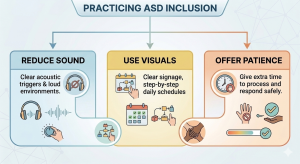
- Modify the Environment: If you run a local business or host community gatherings, consider offering designated “sensory-friendly hours” where music is turned down, lights are dimmed, and crowds are minimized.
- Utilize Visual Supports: Visual aids aren’t just for the classroom. Clear signage, step-by-step schedules, and pictorial guides help individuals navigate public spaces with greater confidence and minimal anxiety.
- Offer Unconditional Patience: When an individual needs extra time to process a question or exhibits self-regulatory behaviors (like hand-flapping or rocking), give them space without judgment.
Celebrating Neurodiversity Every Single Day
Acceptance isn’t a calendar event; it’s a daily commitment to viewing human differences as natural variations rather than deficits. When we embrace neurodiversity, we open our communities up to unique perspectives, innovative problem-solving styles, and deeply authentic human connections.
For families navigating developmental pathways, you do not have to walk this journey alone. Relying on evidence-based, compassionate care ensures that your child is given the tools to translate their inherent strengths into lifelong independence.
What is one way you practice inclusion or support neurodiversity in your local community? Let us know in the comments below to keep the conversation going!
If you are looking for personalized, family-focused support designed to help your child achieve their next developmental milestone, explore our comprehensive ABA therapy programs today.
📍 Serving families across Ohio (Gahanna, Worthington, Nela Park, Mayfield) and Utah (Murray, Salt Lake City area).
👉 Contact us today to learn how professional ABA therapy and evidence-based caregiver coaching can support your entire family’s athletic and developmental journey.