
🧠 AI Summary:
If you have an autistic child who is passionately, intensely, encyclopedically interested in trains, you are in very large company. The connection between autism and trains is one of the most recognized and most studied patterns in autism research — and it is far more meaningful than a quirky coincidence. This blog explores why trains are so compelling for so many autistic individuals, what the neuroscience and psychology behind special interests reveals, the very real benefits that a train obsession provides, and how ABA therapy uses these passions as one of its most powerful tools for building communication, social skills, and independence.
The Child Who Knows Every Train
You know this child.
Maybe they are your child — the one who could name every type of locomotive before they could tie their shoes. Who memorized train schedules the way other kids memorize sports statistics. Who can tell you the exact difference between a diesel-electric and a steam engine, who designed elaborate track layouts across the living room floor, who watches the same train documentary on a loop with a focused, luminous attention that they bring to almost nothing else.
Or maybe you know this child from the waiting room, or from the park, or from the therapy center — the one who lights up the moment anyone mentions trains, who pulls out a model from their bag with the practiced ease of someone who carries this particular treasure everywhere they go.
The connection between autism and trains is one of the most widely recognized patterns in autism — and one of the most consistently misunderstood. Because while many people see a child obsessed with trains and wonder whether the obsession should be limited, redirected, or grown out of, the research tells a different story entirely.
The trains are not the problem. The trains are often the beginning of everything.
Why Trains? The Science Behind the Fascination
The question of why trains have become so iconic as an autism special interest is genuinely interesting — and the answer reveals something important about how the autistic brain engages with the world.
The answer lies in how autism affects attention, sensory preferences, and patterns of thinking. Many people on the autism spectrum are drawn to structured, predictable systems, and trains fit that description perfectly.
Let us break down exactly what makes trains such a natural fit.
Predictability and Structure
Trains are known for their adherence to schedules and repetitive patterns. For individuals with autism who thrive on order and structure, the consistent and predictable nature of trains can be comforting. The repetitive movements and patterns associated with trains can also be highly appealing and provide a sense of familiarity and comfort.
In a world that can feel unpredictable, overwhelming, and full of unwritten social rules that seem arbitrary and constantly shifting, trains are the opposite of all of that. A train goes where the tracks go. It arrives at the scheduled time. It makes the same sounds, follows the same patterns, produces the same visual movements. For an autistic child whose nervous system is genuinely soothed by consistency, a train is not just an interesting object. It is a relief.
Sensory Appeal
Trains are visually captivating, featuring a combination of colors, shapes, and movement. The visual stimulation provided by trains can be appealing to autistic individuals who are drawn to patterns and details.
Beyond the visual, trains offer a rich, multi-sensory experience: the rhythmic sound of wheels on tracks, the vibration of a model train, the complex details of a locomotive’s mechanism. For children who are intensely engaged by specific sensory experiences, trains deliver consistently, predictably, every time.
Systemizing and Pattern Recognition
One of the most consistent findings in autism research is the tendency toward what is called systemizing — a drive to understand, analyze, and build rule-based systems. Trains are extraordinarily systemizable. They have rules: tracks must connect, grades must be manageable, signals must be obeyed, schedules must be maintained. They have categories: steam versus diesel, freight versus passenger, narrow gauge versus standard. They have histories, geographies, and mechanics that can be studied endlessly.
Trains, with their intricate mechanisms and complex systems, can provide an outlet for this intense focus, allowing individuals to delve deep into their fascination and expand their knowledge.
For an autistic child with exceptional pattern recognition and a drive to understand how complex systems work, trains are not just interesting — they are nearly limitless as a domain of knowledge.
Mastery and Expertise
Special interests often provide autistic individuals with a sense of mastery and emotional regulation. Trains, with their complex mechanics and rich history, make an ideal subject for these focused interests.
There is something psychologically profound about being an expert. In a world where social dynamics can feel opaque and skill acquisition in many domains requires the kind of social intuition that doesn’t come naturally, trains offer a domain where depth of knowledge is genuinely achievable — where being the person who knows everything about locomotives is a real identity, and a positive one.
What Special Interests Actually Are
Before going further, it is worth clarifying what research means by “special interests” in autism — because the popular understanding often misses the depth of what is actually happening.
Special, restricted interests are deep, often lifelong passions that many individuals with autism spectrum disorder develop. Unlike hobbies that might come and go, a special interest can be much more intense and consuming. They can revolve around a wide range of topics, from animals to numbers and, quite often, trains.
These interests, for autistic individuals, serve several vital purposes: they bring in a huge amount of routine, help keep anxiety at bay, and serve as a safety zone for them to study things and be creative.
The word “obsession” — frequently used in lay descriptions of special interests — carries a clinical connotation of something disordered or harmful. The research tells a different story. Special interests in autism are not pathological fixations to be treated. They are, for most autistic individuals, one of the most important sources of joy, competence, identity, and regulation in their lives. They are the door through which learning, connection, and confidence often enter.
The Real Benefits of a Train Obsession
If you have been wondering whether you should be concerned about your child’s intense interest in trains — or whether you should try to redirect it toward more “typical” interests — this section is for you.
Emotional Regulation
Engaging in train-related activities can have a calming effect on autistic children. The repetitive motions, predictable movements, and familiar sounds of trains can help regulate a nervous system that often operates under significant sensory and emotional load. In the language of ABA therapy, the train interest functions as a powerful reinforcer — and as a regulation tool that the child has developed for themselves.
Anxiety Reduction
Research suggests that special interests in autism serve several purposes. They can provide a sense of predictability, structure, and order in a world that may feel overwhelming or chaotic.
A child who is anxious, overwhelmed, or dysregulated can often return to their special interest and find genuine relief — not as avoidance, but as a genuine regulatory strategy. The trains are doing real clinical work, even when no one is directing them.
Cognitive Development
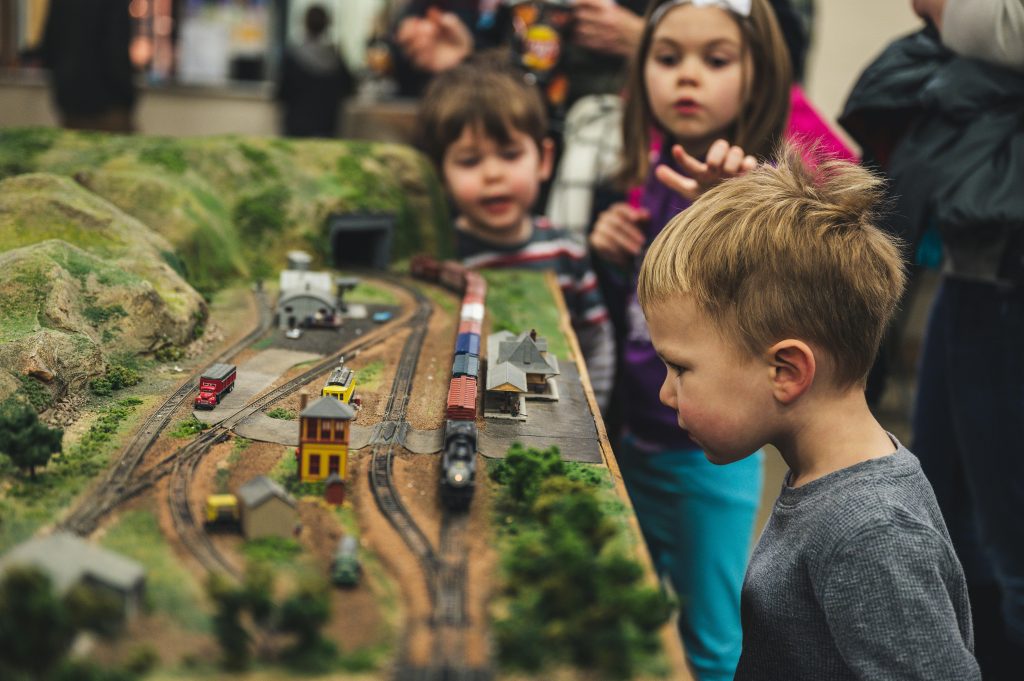
Model trains and train sets offer a tangible way to explore systems, fostering problem-solving, organization, and spatial skills.
Beyond regulation, engagement with trains actively develops cognitive capacities — spatial reasoning, categorization, sequential thinking, memory for detail — that are not just train-related skills. They are transferable cognitive strengths that will serve the child across many domains.
Learning and Academic Engagement
Teachers can apply the themes of trains to teaching students with autism. For example, math lessons can be related to train schedules and travel distances, while history lessons can cover the story of railways. Natural interest in trains can motivate autistic students to engage with academic content that they might otherwise find challenging. Besides the regular curriculum, many children learn time management and spatial awareness with the help of trains.
This is one of the most practically powerful aspects of special interests in autism: they provide a motivational bridge into domains the child might otherwise find inaccessible. A child who cannot engage with abstract arithmetic may engage enthusiastically with calculating how long a train journey takes at a given speed. The content is the same. The motivational context is everything.
Social Connection
Model train clubs or train-watching excursions are great for autistic children to meet new people and increase their social interactions. These activities provide an organized framework in which autistic individuals can practice social skills within a context that they like and understand.
Social interaction is often most accessible for autistic individuals when it occurs within a shared interest context. Two children who both love trains have a conversation structure — a set of topics, a shared vocabulary, a reason to interact — that does not exist in open-ended social settings. The trains become a social scaffold.
How ABA Therapy Uses Special Interests
The most transformative aspect of understanding special interests in autism is what it reveals about how learning works — and how quality ABA therapy approaches it.
At On Target ABA, we build therapy around what a child already loves. Not because we are taking the easy path, but because motivation is the engine of learning — and a child who is intrinsically motivated is a child whose brain is primed for acquisition, retention, and generalization.
Here is what that looks like in practice:
Communication Skill Building
For a child who struggles to initiate communication, trains provide a natural, highly motivating context for communication practice. “Train, please.” “More track.” “Thomas!” — these requests emerge because the child genuinely wants the outcome. Natural reinforcement — the child receives the preferred train-related item or activity — creates a powerful learning loop that table-based drill cannot replicate.
For children working on more complex communication — multi-word utterances, answering questions, maintaining a topic in conversation — the train interest provides endless content. “Which train do you want?” “What does this train do?” “Tell me about this train.” The motivation to engage with these questions in the context of trains creates communication opportunities that would not otherwise exist.
Social Skills Development
Train play is naturally social — tracks need to be connected together, trains need to be loaded and unloaded, scenarios need to be agreed upon. For a child working on joint attention, turn-taking, or collaborative play, train activities provide a structured, motivating context for exactly these skills.
For older children and adolescents, shared train interest becomes a pathway to peer connection — a context in which the child has genuine expertise and something real to offer to a social interaction. Model train clubs, online communities, and train-watching groups provide organized social structures that many autistic individuals find more accessible than open-ended social settings.
Emotional Regulation Within Sessions
A child who is dysregulated cannot learn. A child who is engaged with something they love is in a regulated, receptive state. Incorporating train-related activities into sessions — as transitions, as reinforcers, as the primary context for skill work — keeps the child regulated and engaged in ways that non-preferred activities cannot.
This is not just about making therapy feel nice. It is about putting the child’s brain in the state where learning is actually possible.
Generalization and Flexibility
One of the long-term goals of ABA therapy is generalization — the transfer of skills from the teaching context to the real world. Skills learned in the context of a child’s special interest tend to generalize better than skills learned in artificial contexts, because the interest-based context is more similar to the natural environments where the skill will be used.
A child who learns to request, take turns, and engage in joint attention during train play is more likely to apply those skills in other naturalistic settings — because the learning happened in a naturalistic, motivating context to begin with.
A Note on Honoring Special Interests
There is a broader message in the research on special interests that we believe deeply at On Target ABA.
Special interests are not something to be redirected, limited, or grown out of. They are one of the most important and positive aspects of many autistic individuals’ lives. They provide joy, competence, identity, regulation, and connection. They deserve to be honored, celebrated, and used — not as a reward to be rationed, but as the natural, valuable expression of a specific and beautiful mind.
When a child arrives at On Target ABA with a passion for trains — or dinosaurs, or maps, or numbers, or a particular video game, or the makes and models of every car ever manufactured — we do not see a problem. We see a door.
And we walk through it, together.
Frequently Asked Questions
Q: Is it normal for autistic children to be obsessed with trains?
Very common, yes. The connection between autism and trains is one of the most recognized patterns in autism. Special interests — whether trains, dinosaurs, maps, numbers, or anything else — are a core feature of autism for many individuals and serve important regulatory, cognitive, and social functions.
Q: Should I try to limit my child’s interest in trains?
In most cases, no. Research consistently shows that special interests provide significant benefits — emotional regulation, anxiety reduction, cognitive development, and social connection. The appropriate goal is not to limit the interest but to use it — as a motivational bridge, a communication context, a social scaffold, and a source of genuine joy.
Q: How does ABA therapy use my child’s love of trains?
Quality ABA therapy builds motivation-based programs that incorporate a child’s special interest as the primary context for skill-building. Communication targets, social skills goals, emotional regulation strategies, and daily living skill practice can all be embedded in train-related activities that the child is genuinely motivated to engage with.
Q: My child only wants to talk about trains. Is this a concern?
A child who is intensely focused on trains in a way that prevents any other engagement — with people, with activities, with learning — may benefit from support to expand their flexibility. But the approach is never to eliminate the interest. It is to build skills that allow the child to access more of their world, including the trains, more effectively. Work with your child’s BCBA to identify the balance that serves your child.
Q: Do all autistic children love trains?
No. Trains are a common special interest, but special interests vary enormously across autistic individuals. Some children love trains; others are passionate about dinosaurs, numbers, weather, maps, music, or a specific TV franchise. The pattern is not the specific interest — it is the intensity, the depth, and the function the interest serves.
.
At On Target ABA, we serve children ages 2–12 across Ohio and Utah with center-based, home-based, and school-based ABA therapy. We accept most major insurance plans and Medicaid.
→ Contact us to learn about our motivation-based approach to ABA therapy
→ Read: What is Pivotal Response Treatment? ABA that follows the child’s lead
→ Read: Play-based ABA — why the best therapy feels like play
→ Read: Natural Environment Teaching — how ABA meets children where they are