🧠 AI Summary:
This April, the team at On Target ABA’s Gahanna EL Center did something beautiful: they planned a special sensory activity for every Tuesday of Autism Acceptance Month to celebrate the children they serve. Week one was a Bubble & Music Party — a joyful, sensory-rich celebration that was so much more than a party. This blog tells the story of that day, explains why sensory play is so powerful in the context of ABA therapy, and shares what autism acceptance looks like when it moves from a slogan into a room full of children, bubbles, and music.
A Room Full of Bubbles and Pure Joy
Picture this.
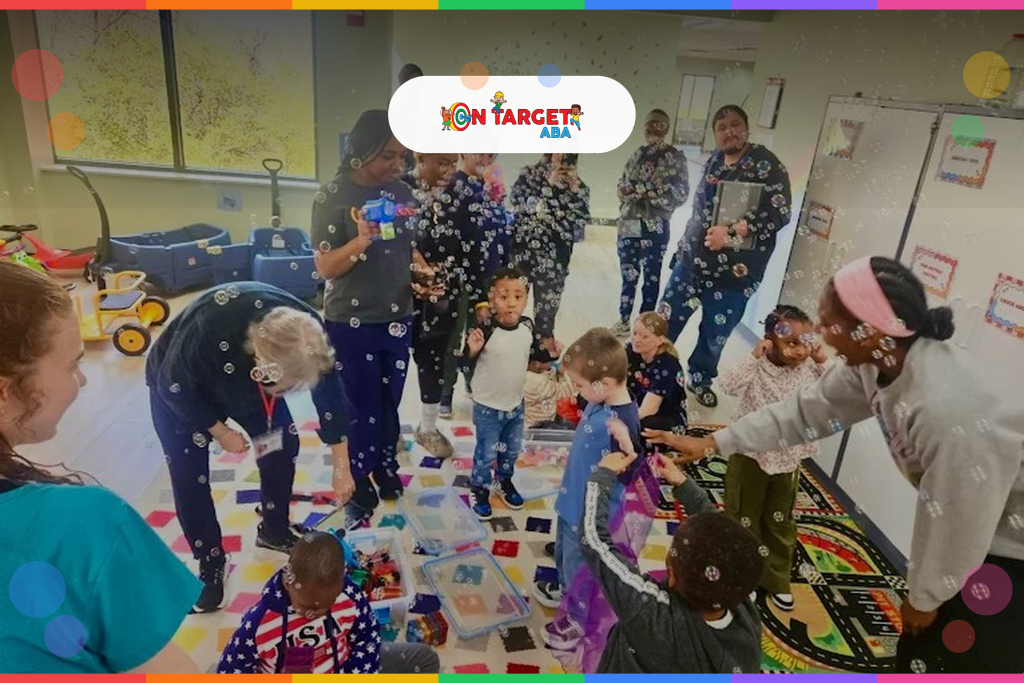
A room full of children — eyes wide, arms reaching, mouths open in laughter. Bubbles floating through the air in every direction, catching the light, landing on tiny outstretched hands. Music playing in the background. Therapists laughing alongside the children they’ve spent months building relationships with. The pure, uncomplicated sound of joy filling every corner of the space.
This is what Autism Acceptance Month looks like at On Target ABA’s Gahanna EL Center.
Not a passive acknowledgment. Not a poster on a wall. Not a social media graphic posted and forgotten. A room full of bubbles, music, and children who are celebrated — completely, genuinely, and with their whole team behind them.
Sensory Tuesdays: A Month of Intentional Celebration
This April, the Gahanna EL Center team made a commitment: every Tuesday of Autism Acceptance Month, they would plan a special sensory activity for the children in their care. Not because it was required. Not because it was on a checklist. But because the children they serve deserve to be celebrated — and because the people who work at On Target ABA understood that celebration, like therapy, is most powerful when it’s intentional.
The concept was simple and brilliant: take a month that the broader world uses for awareness campaigns and social media posts, and turn it into something tangible. Something the children could experience. Something the team could build together. Something that would make every Tuesday in April feel like the day was made for them.
Week one was the Bubble & Music Party. And it was everything.
What Happened That Tuesday
The setup was deceptively simple: bubble machines, bubble guns, music, and the whole team. But what happened when those elements came together was anything but simple.
Children who sometimes struggle to engage became absorbed in tracking bubbles floating through the air. Kids who find transitions difficult moved freely through the space, drawn naturally from one end of the room to the other by the movement of the bubbles. Children who rarely initiate physical interaction reached out instinctively — toward bubbles, toward therapists, toward each other.
The music added a layer of rhythm and predictability that many autistic children find regulating. Some children hummed along. Some moved to the beat. Some simply became calmer in the presence of familiar, pleasant sound layered over the visual magic of the bubbles.
And the faces. The faces of the children in that room told the whole story. Open-mouthed wonder. Full-body delight. The kind of happiness that doesn’t perform for anyone — that simply exists because this moment is too good to contain.
The therapists were right there with them. Not standing at a distance observing. Not managing the activity from across the room. In it — laughing, reaching for bubbles alongside the children, celebrating every moment of connection and joy that the day produced.
This is what the team at On Target ABA’s Gahanna EL Center means when they talk about showing up for their kids.
Why Sensory Play Is So Much More Than Fun
The Bubble & Music Party was a celebration. It was also, in every meaningful sense, therapy in action.
Sensory play — activities that engage and stimulate the sensory systems in intentional, enjoyable ways — is a core component of how we support autistic children at On Target ABA. And the reasons go much deeper than simply providing something enjoyable to do.
Sensory regulation. Many autistic children experience the world with heightened or altered sensory processing. Sounds are louder. Lights are brighter. Textures are more intense. Sensory play in a controlled, joyful context helps children practice tolerating and enjoying sensory input in a safe environment — building the regulatory capacity that supports everything else.
Visual tracking and attention. Bubbles are extraordinary for this. They are unpredictable — they move, they float, they drift, they pop. Tracking them requires sustained visual attention across the full visual field. For children working on eye tracking and sustained focus, a room full of bubbles is a naturalistic, highly engaging exercise in exactly those skills.
Reaching and gross motor development. The instinct to reach for a bubble — to try to catch it, touch it, pop it — activates gross and fine motor pathways in a way that feels effortless and playful. Children who might resist structured gross motor exercises participate enthusiastically when the goal is catching a bubble.
Social initiation and joint attention. Sensory play in a group context creates natural opportunities for joint attention — the shared focus on a common object or event that is one of the foundational building blocks of social connection. When two children both reach for the same bubble at the same time, they are practicing joint attention without any clinical instruction.
Communication opportunities. Bubbles create reasons to communicate. “More bubbles!” is often one of the first functional requests children with limited communication make in sensory play contexts. “Look at that one!” is an initiation. Reaching toward a therapist to direct their attention is a gesture. The activity creates a natural communication-rich environment.
Regulation through music. Music engages the brain differently from other stimuli. The predictable rhythm of music provides a kind of scaffolding that many autistic children find organizing — it gives structure to a moment, predictability to a space, and a sensory anchor that helps regulate arousal levels. Music therapy as a standalone intervention has a robust evidence base, and the integration of music into sensory play extends those benefits into an everyday context.
Every bubble that floated through that room on the first Tuesday in April was doing clinical work — because quality ABA therapy and genuine joy are not in opposition. They live in the same space.
What Autism Acceptance Really Looks Like
April is full of the language of autism awareness and acceptance. And that language is important — the shift from “awareness” to “acceptance” represents a meaningful evolution in how the world thinks about autistic people.
But language is only the beginning. What matters more is what acceptance actually looks like in practice.
Autism acceptance looks like a team of therapists who choose to spend their April Tuesdays planning sensory celebrations for the children in their care — not because anyone asked them to, but because they wanted to.
It looks like a room that says to every child: you are celebrated here, exactly as you are. Not a version of you that is more typical, more quiet, more still. You — the child who reaches for bubbles with their whole body, who makes sounds of pure delight, who stims with joy when the music plays.
It looks like professionals who understand that a child’s laugh is data — that the quality of a child’s experience in therapy matters enormously, not just as a means to clinical ends but as a value in itself.
It looks like a Bubble & Music Party.
At On Target ABA, we believe that acceptance is not a month. It is a daily practice, visible in the small decisions that the people in our centers make every single day. The team at the Gahanna EL Center embodies that practice — and we are so proud of them.
Why Sensory Activities Work So Well in ABA Therapy Settings
The research on sensory play in early childhood is extensive, and its integration into ABA therapy settings reflects a growing understanding that the most effective therapy is the therapy children actively want to participate in.
Here’s why sensory activities are particularly powerful in the ABA context:
Motivation. ABA therapy relies on motivation — the use of reinforcing activities and items to make learning worth the effort. When the therapy itself is genuinely enjoyable, intrinsic motivation rises. Children who are having fun are more engaged, more communicative, and more willing to try new things.
Naturalistic learning. The Natural Environment Teaching approach — a core component of quality ABA — emphasizes embedding learning opportunities into naturally occurring, enjoyable activities. Sensory play creates exactly this: a rich, naturalistic context full of opportunities to practice communication, social, motor, and cognitive skills without the artificiality of a table-based drill.
Generalization. Skills learned in highly enjoyable contexts tend to generalize more readily than skills learned in neutral or aversive ones. When a child learns to request, initiate, or make eye contact in the context of something they love, that skill is more likely to appear in other enjoyable contexts across their day.
Therapeutic relationship. The relationship between a child and their RBT is the foundation of everything else in ABA therapy. Shared positive experiences — like a Bubble & Music Party — deepen that relationship in ways that improve the effectiveness of all subsequent therapy. A child who has danced through bubbles with their therapist trusts that therapist more fully.
Stay Tuned: Sensory Tuesdays Continue All Month
The Bubble & Music Party was Week One. The Gahanna EL Center team has more Tuesdays planned — and each one is designed with the same intentionality, care, and genuine joy that made the first Tuesday so memorable.
We’ll be sharing each week’s celebration here and on our social channels throughout April. If you’re a family whose child is part of the Gahanna EL Center community, know that your child is being celebrated by a team that genuinely loves what they do and who they do it for.
And if you’re a family who is not yet connected with On Target ABA — this is what we’re about. This is the culture we build. This is what it looks like when a team shows up for the children in their care with their whole hearts.
Happy Autism Acceptance Month. ♾️💙🌈
About On Target ABA
On Target ABA provides center-based, home-based, and school-based ABA therapy for children ages 2–12 across Ohio and Utah. We accept most major insurance plans and Medicaid, and offer on-site autism evaluations.
→ Contact us to learn about ABA therapy services in Ohio and Utah
→ Read: What is sensory play and why does it matter in ABA therapy?
→ Read: Why the best ABA therapy feels like play
→ Read: Stimming and autism — what it is and why it should never be suppressed
→ Read: Natural Environment Teaching — how ABA therapy meets children where they are