
🧠 AI Summary:
At On Target ABA, Autism Awareness & Acceptance Week isn’t just something we acknowledge — it’s something we celebrate with our whole team. This blog shares the story behind our Mismatch Shoe Tuesday spirit week event, the beautiful message it carries about individuality and neurodiversity, and what autism acceptance really means in the context of the work we do every single day. A huge shoutout to peer facilitator Makaila Still for making it all happen.
Some Days, the Message Is in the Shoes
On an ordinary Tuesday at On Target ABA, something a little extraordinary happened.
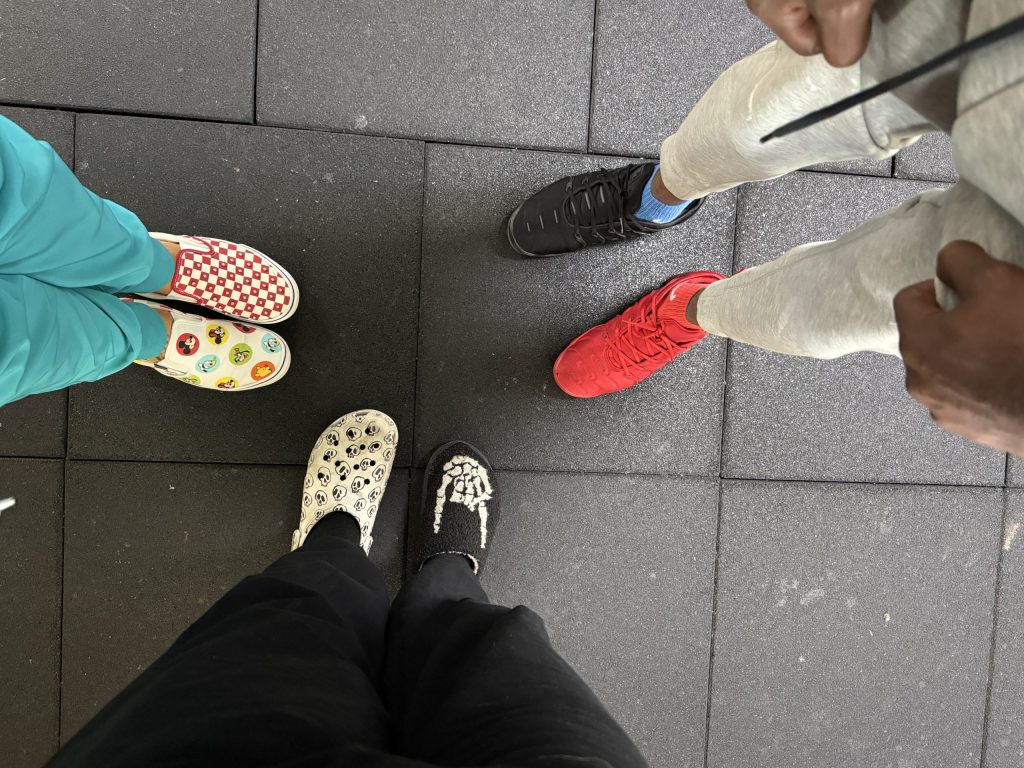
Our team showed up to work wearing mismatched shoes.
One pink Croc and one dark Croc. A red sneaker paired with a rainbow one. A Ugg boot next to a black flat. White Crocs next to a decorated one. Checkered Vans alongside spotted slides.
Every pair different. Every combination intentional. Every shoe a small, joyful declaration of something we believe deeply: that difference is not a deficit. It is a gift.
Welcome to Mismatch Shoe Tuesday — one of the highlights of our Autism Awareness & Acceptance Spirit Week at On Target ABA. And a huge thank you to our incredible peer facilitator Makaila Still, whose creativity and heart brought this week to life for our entire team.
Why Spirit Week? Why Shoes?
Autism Awareness & Acceptance Week is observed every April as part of Autism Awareness Month — a time when the autism community, advocates, families, and professionals come together to increase understanding, reduce stigma, and celebrate the full humanity of every autistic person.
At On Target ABA, we take this seriously. Not just during April, but every day of the year. Our work is built on the belief that every child we serve is a whole person — with unique strengths, unique challenges, unique preferences, and a unique story that deserves to be honored, not erased.
Spirit week is our way of making that belief visible. Of turning an internal value into an external celebration. Of giving our team a fun, tangible way to say: we see you, we celebrate you, and we’re proud to do this work.
And why shoes? Because the metaphor is perfect.
Just like every pair of shoes looks different — every person is unique in their own special way.
No two pairs at On Target ABA looked the same on Mismatch Shoe Tuesday. And that was entirely the point.
The Story Behind the Spirit Week: A Shoutout to Makaila Still
Spirit weeks don’t create themselves. They require someone with vision, energy, and genuine love for the people around them.
For our team, that person was Makaila Still, our peer facilitator, who designed and organized this entire spirit week from the ground up.
Makaila’s idea was simple and powerful: give the team a way to participate in Autism Awareness & Acceptance Week that was fun, inclusive, accessible, and meaningful. No pressure. No performance. Just an invitation to show up a little differently — and in doing so, say something important about how we feel about difference itself.
The result was a week that our team won’t forget. And Mismatch Shoe Tuesday was the moment that captured it best: a hallway full of adults wearing completely mismatched shoes, laughing together, taking photos, and feeling genuinely connected to the mission that brings us to work every day.
Makaila — from everyone at On Target ABA — thank you. You are a rockstar. 🌟
What Autism Acceptance Actually Means
Autism Awareness Month has evolved significantly over the past two decades. The conversation has shifted — and rightly so — from awareness alone toward something deeper and more meaningful: acceptance.
Awareness says: autism exists.
Acceptance says: autistic people belong — fully, completely, and without conditions.
The distinction matters enormously, especially for families navigating an autism diagnosis and for the children who will grow up in a world that either embraces or marginalizes who they are.
At On Target ABA, acceptance is not a talking point. It is woven into every clinical decision we make:
- We build therapy goals around each child’s quality of life and individuality — not around making them appear more neurotypical
- We celebrate every form of communication — verbal, nonverbal, AAC, gesture, and everything in between
- We never use techniques that cause distress or ask children to suppress behaviors that are natural to them without clinical justification
- We involve families as partners, not recipients, because parents know their children in ways no therapist ever fully will
- We recruit and develop professionals who understand that this work is a privilege — and who show up for the children they serve with genuine investment, not just clinical obligation
TheAutism acceptance, in practice, looks like a BCBA designing a program around a child’s obsession with trains because that’s where the learning will actually happen. It looks like an RBT following a child’s lead during a play session instead of redirecting them to a table. It looks like a team celebrating a child’s first word at age four with the same joy and reverence that the child’s mother feels.
And sometimes, it looks like a team showing up to work in mismatched shoes. Because joy is not frivolous — it is part of the culture that makes great therapy possible.
Neurodiversity: The Heart of the Message
The concept of neurodiversity holds that neurological differences — including autism, ADHD, dyslexia, and others — are natural variations in the human genome, not disorders to be fixed or eliminated.
This doesn’t mean that autism comes without challenges. It does — real ones, that affect daily life, communication, relationships, and independence. The children and families we serve face those challenges every day, and ABA therapy exists to help.
But it does mean that the goal of therapy should never be to erase who a child is. It should be to support them in becoming more fully, freely, and confidently themselves.
The mismatched shoes said this without a single word.
No pair was wrong. No combination was a mistake. Every shoe that walked through our doors on Tuesday belonged exactly there — different, unexpected, and completely right.
That is neurodiversity. That is what we celebrate.
What Spirit Week Means for Our Team
For the professionals who work in ABA therapy, the work is meaningful — and demanding. BCBAs and RBTs give a great deal of themselves to the children they serve. They show up on hard days and good ones. They celebrate incremental progress with genuine excitement. They carry the stories of the children they work with long after the sessions end.
Spirit week is a gift back to them. A reminder that the culture of this organization is one that values joy, connection, creativity, and belonging — not just clinical metrics and productivity.
When a team feels celebrated, they show up differently. When professionals feel seen, they provide better care. When a workplace culture reflects the values of the work itself — inclusion, acceptance, the celebration of difference — it creates something that families notice immediately when they walk through the door.
That’s the kind of culture we’re building at On Target ABA. And Mismatch Shoe Tuesday was a beautiful glimpse of it.
How Families Can Celebrate Autism Acceptance Month
Autism Awareness & Acceptance Month doesn’t have to be limited to professionals and advocacy organizations. Families can participate too — in ways that are meaningful, accessible, and genuinely celebratory.
Here are some ideas:
Celebrate your child’s unique interests. Whatever your child loves most — trains, dinosaurs, a specific song, a particular texture — lean into it this month. Let it be the center of an activity, a conversation, or an outing. Their passions are part of who they are.
Learn something new about autism. Read a book by an autistic author. Watch a documentary told from autistic perspectives. Follow autistic advocates and creators on social media. Understanding widens the circle of acceptance.
Talk about difference positively. With your child, with their siblings, with your extended family. Use language that honors who your child is — not language that frames autism as a tragedy or a limitation. Your words shape how your child understands themselves.
Connect with other autism families. Community is one of the most powerful forms of support available to autism families. Whether it’s an in-person support group, an online community, or a friendship with another family in your therapy waiting room — you don’t have to do this alone.
Advocate. In your child’s school, in your workplace, in your neighborhood — push for spaces and systems that genuinely include autistic people. Awareness is a starting point. Advocacy is what changes things.
And maybe — wear mismatched shoes. Because sometimes the simplest gestures carry the most meaning.
A Note From On Target ABA
Every child we serve at On Target ABA has something remarkable about them. Something that makes them distinctly, irreducibly themselves. Our job — the job we show up for every single day — is to support them in becoming more fully that person. More communicative. More independent. More connected. More free.
That job is serious. It is evidence-based and carefully supervised and relentlessly individualized. And it is also full of joy — because children teach us that learning and laughter belong together, and that the best therapy happens when both are present.
During Autism Awareness & Acceptance Week and every week, we celebrate the children we serve. We celebrate the families who trust us. We celebrate the team members — like Makaila — who bring creativity and heart to everything they do.
And we celebrate difference. Because difference is not something to overcome. It is something to honor.
Just like every pair of shoes looks different — every person is unique in their own special way. 💙
On Target ABA serves children ages 2–12 across Ohio and Utah with center-based, home-based, and school-based ABA therapy. We accept most major insurance plans and Medicaid.
→ Contact us to learn more about our approach to ABA therapy
→ Read: ABA therapy ethics — what every family should know
→ Read: Why the best ABA therapy feels like play
→ Read: The reality of autism caregiving — from both sides